
As of 2026, England currently has a network of existing smart motorway sections across the M1, M6, M25, M4, M5, M20, M23, M27, M42, M56, M60 and M62. Following widespread safety concerns from motoring organisations and drivers, the government permanently cancelled all plans for new smart motorway construction.
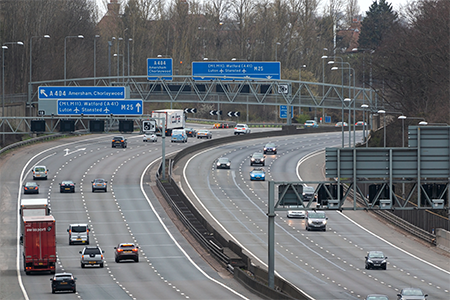
Existing smart motorways remain in operation, while National Highways continues to maintain and upgrade their safety and traffic-management systems:
- Focus on Safety: A £900 million government investment project has delivered over 150 new emergency refuge areas across the network. National Highways has also completed comprehensive upgrades to its Stopped Vehicle Detection (SVD) radar technology, which rapidly detects broken-down vehicles stranded in live lanes.
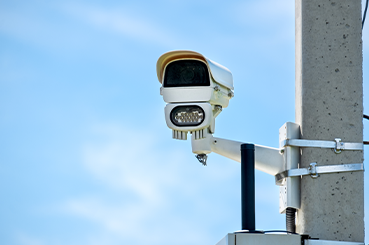
- Speeding Fines: Variable speed limits remain legally enforceable. National Highways supplies speed-detection equipment to the police, which are responsible for enforcement. A technical issue affecting some variable-speed cameras was identified in 2025 and became the subject of a government review in 2026.
If you are unsure how these roads operate, the core functionalities remain straightforward:
- Variable Speed Limits: Speed limits adjust in real time to smooth traffic flow and prevent sudden braking.
- Dynamic Lane Management: Hard shoulders can open as active running lanes during busy periods to boost capacity.
- Overhead Signalling: Electronic displays give drivers immediate information regarding speed limits, lane closures, and hazards ahead.
Understanding how these features operate ensures you can complete your journeys safely and confidently. For comprehensive guidance on navigating high-speed roads, explore our full guide to motorway driving in the UK.
What is a Smart Motorway and why do we have them?
National Highways continues to operate and maintain existing smart motorways to help manage traffic flow and congestion across England. While early rollouts faced significant public criticism, substantial investments in safety infrastructure have helped improve overall reliability.
The central purpose of smart motorways is to increase road network capacity without building entirely new motorways. This capacity is managed using two main techniques:
- Opening the hard shoulder to traffic: Converting the hard shoulder into a live lane during peak periods increases overall road capacity. However, safety concerns over removing permanent hard shoulders led directly to the cancellation of future all-lane running schemes, focusing efforts on upgrading existing stretches instead.
- Variable speed limits: Dynamic speed changes smooth out traffic flow, reducing stop-start driving conditions and cutting tailbacks.
Technology for Safety and Efficiency
Modern smart motorways rely on integrated technology to manage traffic safety:
- Stopped Vehicle Detection (SVD): Advanced radar systems automatically detect stationary vehicles in live lanes, immediately sending warnings to approaching traffic via overhead gantries.
- Overhead electronic signs: Displays communicate compulsory speed limits, hazard warnings, and red ‘X’ lane closures.
- CCTV cameras: Extensive camera networks monitor traffic conditions continually, allowing control centres to respond rapidly to incidents.
Types of Smart Motorways
Believe it or not, there are actually three types of Smart Motorways: controlled motorways, dynamic hard shoulder running schemes and all-lane running schemes.
Controlled Motorways
Controlled motorways feature three or more running lanes regulated by variable speed limits. Crucially, controlled motorways always retain a permanent hard shoulder that is reserved strictly for genuine emergencies.
Dynamic hard shoulder
Dynamic hard shoulder motorways operate like traditional motorways most of the time, keeping the hard shoulder closed for emergency use only. However, when traffic volume increases, control rooms can open the hard shoulder as a live lane to ease congestion.
Overhead gantries clearly inform drivers whether the dynamic hard shoulder is open. If an incident occurs on the hard shoulder while it is operating as a live lane, gantries will display a red ‘X’ symbol above lane one. Driving in a lane marked with a red ‘X’ is illegal and carries automated fines and penalty points.
Overhead displays also set compulsory variable speed limits during busy periods or incidents. Enforced by dedicated cameras, these limits adapt dynamically to keep traffic moving steadily.
All lane running schemes
On all-lane running motorways, the permanent hard shoulder has been entirely replaced with a permanent active lane to maximise traffic capacity.
Lane one only closes to normal traffic if an incident occurs. In these situations, overhead gantries display a red ‘X’ symbol to indicate the lane is closed.
Just like dynamic schemes, gantries display enforced speed limits that are monitored by automated speed cameras. Control centres can close any lane using red ‘X’ signs whenever hazards arise.
Emergency refuge areas (ERAs) are built along these stretches to provide safe stopping places. Following recent construction programmes, these emergency areas are placed at regular intervals to give drivers a safe exit point if their vehicle breaks down.
Speed Limits and Smart Motorway Speed Cameras
Variable speed limits are used to manage traffic flow, smooth congestion and reduce stop-start traffic. Dynamic limits adjust instantly to traffic conditions, smoothing out traffic flow and reducing harsh braking. Maintaining steady traffic speeds also discourages dangerous tailgating.
Smart motorways are particularly effective at catching speeding motorists, which has drawn debate over revenue generation. Motoring groups, including the AA, have frequently questioned how speed fine revenue is managed.
In response to concerns, National Highways maintains that variable speed cameras exist solely to protect road users and manage traffic flow, rather than generate revenue.
During your journey, variable speed limits can change quickly. When no speed limit is displayed on the gantry signs, the national speed limit of 70mph applies.
Gantries house modern, calibrated speed cameras across individual lanes. Variable speed limits can be enforced by speed cameras, with enforcement carried out by the police. To learn more about how different speed cameras operate, read our complete guide to types of traffic cameras in the UK.
Breaking down on a Smart Motorway
Vehicle breakdowns can happen even on smooth journeys. If your vehicle experiences mechanical failure on a smart motorway, taking immediate, correct action is essential for your safety:
- Always switch on your vehicle hazard warning lights immediately.
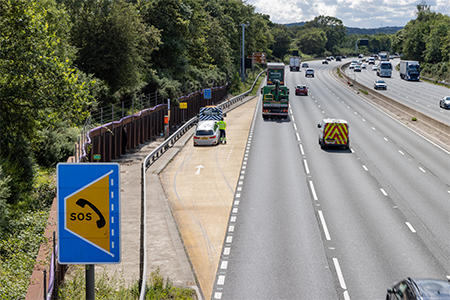
- Try your best to reach an Emergency Refuge Area (ERA). These areas are marked by large blue signs containing an orange SOS phone icon. Once safely stopped inside the refuge area, use the dedicated SOS emergency phone to contact National Highways.
- If you cannot reach an ERA, steer onto the verge if there is no safety barrier and it is safe to do so.
- Should your vehicle stop in the nearside lane next to a barrier, exit through the left-hand passenger doors. Never step out into active traffic lanes. Stand well behind the safety barrier, away from moving vehicles.
- If your car breaks down stranded inside an active traffic lane, stay inside your vehicle with your seatbelt securely fastened. Keep your hazard lights on and call 999 immediately.
For detailed advice on navigating broken-down shoulder lanes safely, see our complete guide on hard shoulder rules and UK motorway safety.
Quick Tips for Smart Motorways:
Never drive in a lane closed with a red X symbol
Keep to the speed limit indicated by the gantries. If no speed is designated, stick to the national speed limit (70mph)
A solid white line indicates the hard shoulder and shouldn’t be driven in unless directed to
A broken white line indicates a normal running lane
In the event of vehicle difficulties (warning lights etc.), exit the motorway as soon as possible
For emergencies where there is no hard shoulder, use the Emergency Refuge Areas if possible
Put your hazard lights on in the event of a breakdown