
If you drive an electric vehicle, or if you are thinking about buying one soon, you have probably noticed headlines about new road tax rules coming down the line. Terms like pay-per-mile driving tax and eVED tax have been popping up everywhere, leaving many drivers wondering what these changes mean for their bank accounts.
Navigating car tax rules can often feel overly complicated. To help clear up the confusion, this guide breaks down the core eVED meaning, explains why the government is introducing it, and details exactly what it will cost you based on your annual mileage.
What is eVED?
To define it plainly for anyone who has only seen the headlines, eVED stands for Electric Vehicle Excise Duty. It is an extension of the existing Vehicle Excise Duty (VED) framework rather than a complete replacement of the road tax system you already use.
Under this new scheme, drivers of zero-emission and low-emission cars will be charged based on the distance they travel each year. The government announced eVED at Budget 2025 and launched a public consultation that ran until 18 March 2026. The official response to that consultation was published on 13 July 2026, setting the formal framework for the system into law.
In simple terms, instead of paying a flat yearly fee, your tax bill will scale alongside the number of miles recorded on your odometer.
Why the government is introducing it
The transition to electric motoring is speeding up across the country, which presents a significant structural challenge for public finances. Traditional petrol and diesel drivers contribute substantially to the Treasury every time they visit a filling station through fuel duty. Electric vehicle drivers do not buy petrol or diesel, so they do not pay this tax. The Office for Budget Responsibility (OBR) forecasts that fuel duty income will fall steadily as more motorists make the switch to electric cars. The government is introducing eVED to plug this growing revenue gap and ensure all road users contribute to highway funding.
When does eVED start?
The new rules come into force on 1 April 2028.
You will pay eVED when you first renew your standard VED after that date. It is worth emphasising this clearly, as the most common worry among motorists is that the tax is active right now. It does not affect your tax bill today. You have plenty of time to prepare, and any payments under the per-mile system are still some time away.
How much is eVED?
The exact charge depends directly on the type of vehicle you drive:
- 3p per mile for battery electric cars and hydrogen fuel cell cars.
- 1.5p per mile for plug-in hybrids.
The lower plug-in hybrid rate exists to avoid charging drivers twice for the same journey. Plug-in hybrid owners already pay fuel duty at the pump whenever they run their car on petrol or diesel, so a discounted mileage rate keeps the taxation fair.
Starting from the 2029 to 2030 tax year onwards, these base rates will rise annually in line with CPI inflation.

What eVED could add to your annual bill
Because eVED is calculated per mile, your total cost comes down to your personal driving habits. Here is what the 3p per mile rate for fully electric cars looks like across common annual mileages:
- 5,000 miles a year: £150
- 7,500 miles a year: £225
- 10,000 miles a year: £300
- 15,000 miles a year: £450
If you drive a plug-in hybrid, your cost will be exactly half of those amounts. For example, covering 10,000 miles a year in a plug-in hybrid will add £150 to your annual bill. It is important to remember that these sums come on top of your standard annual road tax rather than replacing it entirely.
Which vehicles pay eVED
At launch, eVED applies exclusively to passenger cars. This includes battery electric, plug-in hybrid, and hydrogen fuel cell cars.
Electric vans, buses, coaches, motorcycles, and heavy goods vehicles (HGVs) are completely out of scope when the scheme begins. The government excluded these commercial categories because those specific markets are at an earlier stage in their transition to electric power. Around 5.6 million vehicles are expected to fall within the scope of eVED during the 2028 to 2029 financial year.
How you will pay eVED
Many drivers worry that a per-mile tax means fitting a tracking device or installing GPS equipment in their vehicle. You can rest assured that this is not the case. There is no vehicle tracking, and no location monitoring involved.
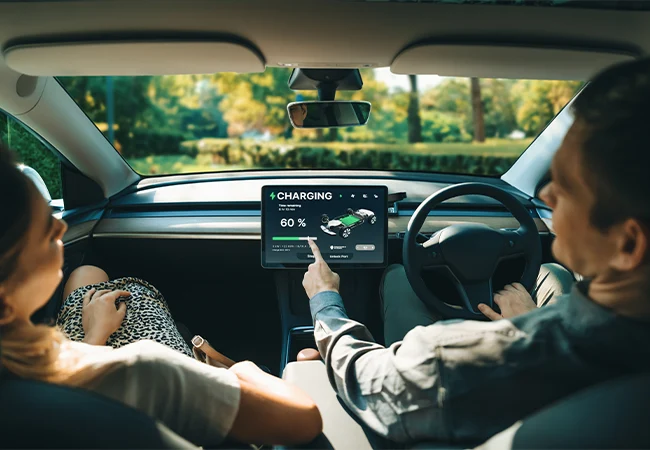
The DVLA will administer eVED directly through the existing road tax renewal system. When your tax renewal is due, you will provide an odometer reading along with an estimated mileage for the upcoming year. You can choose to pay the total upfront or spread the cost over monthly instalments.
When you renew the following year, a year-end mileage reading creates a simple reconciliation process. If you drove fewer miles than estimated, you receive a credit; if you drove more, the difference is added to your new balance without any fines or penalties. For vehicles that require an MOT, your mileage will be checked directly against official MOT test records, meaning there is usually nothing extra for you to do.
eVED comes on top of road tax, not instead of it
This is the element of VED on electric cars that is most likely to be misunderstood. It is vital to recognise that eVED is an additional charge that builds upon the existing VED structure.
Electric cars have already paid standard VED since 1 April 2025. Here is how the current baseline road tax rules apply to zero-emission cars right now:
- New zero-emission cars pay the lowest first-year rate at registration, before moving to the standard annual rate from year two.
- Zero-emission cars registered between 1 April 2017 and 31 March 2025 pay the standard annual rate.
- Zero-emission cars registered between 1 March 2001 and 31 March 2017 sit in the lowest CO2 tax band.
Additionally, the threshold for the Expensive Car Supplement on zero-emission vehicles rose from £40,000 to £50,000 on 1 April 2026. This means a mainstream electric car with a list price under £50,000 completely avoids that extra annual fee. When 2028 arrives, your eVED mileage payment will simply be added to these standard road tax figures.
Will an electric car still be cheaper to run?
The overall financial comparison requires looking at all running costs together. The government’s stated position is that a 3p per mile tax rate remains roughly half of what an average petrol or diesel driver pays in fuel duty alone per mile, given that fuel duty currently sits at 52.95p per litre.
To work out your overall picture, you need to weigh eVED against your charging setup:
- Home charging: Drivers who charge overnight on off-peak energy tariffs will still enjoy significantly lower fuel costs per mile compared to buying petrol or diesel, even after adding 3p per mile for eVED.
- Public charging: If you rely heavily on fast public chargers, your per-mile costs will naturally sit closer to traditional fuel costs once eVED is included.
Keep in mind that electric vehicles also benefit from fewer moving engine parts, which often translates into lower routine servicing costs. Furthermore, many urban areas continue to offer clean air zone and congestion charge exemptions for zero-emission vehicles. Rather than relying on an unqualified claim that electric cars are unconditionally cheaper, calculate your annual mileage alongside your home charging rates to see your exact savings.
What eVED means if you are buying an electric car now
If you are planning to buy an electric car today, there is no need to panic or rewrite your plans. The primary detail to keep in mind is that eVED will apply to existing electric cars as well as newly registered ones when 1 April 2028 arrives. You cannot bypass the per-mile tax simply by purchasing your car before the start date.
The best practical step you can take today is to work out your average annual mileage. Because mileage is the single metric that determines your future eVED rate, knowing your annual distance makes it easy to calculate your future running costs accurately.

eVED FAQs
Is eVED already in force?
No. The system does not start until 1 April 2028, so it will not impact your current tax bill today.
Does eVED replace road tax?
No. It is an additional per-mile charge that sits on top of standard Vehicle Excise Duty.
Will my car be tracked?
No. The system relies entirely on annual odometer readings and MOT records, not GPS tracking or telematics devices.
Do electric vans pay eVED?
No. Electric vans, buses, HGVs, and motorcycles are out of scope at launch.
What if I estimate my mileage wrong?
Your next annual odometer reading will trigger a simple balance reconciliation, adjusting your bill up or down without penalties.
Do plug-in hybrids pay the full rate?
No. Plug-in hybrids pay a reduced rate of 1.5p per mile because they already pay fuel duty on petrol or diesel.
Does eVED apply to cars I already own?
Yes. When the scheme launches in 2028, it applies to existing zero-emission cars on the road as well as new registrations.
Curious about how your current car fits into your long-term budget? Check your car’s current part-exchange valuation online today to explore your options before the new tax rules arrive.