
Established in 1937, Toyota Motor Corporation is a Japanese car manufacturer synonymous with reliability. It built its first plant in Koromo, a city that is now named Toyota after the global car manufacturing giant.
But Toyota’s story doesn’t start with cars, it starts with looms. So how did a weaving business become Toyota?
To understand this, we need to go back before the first car, to the invention that made it possible.
Before the Cars: The Toyoda Loom Story
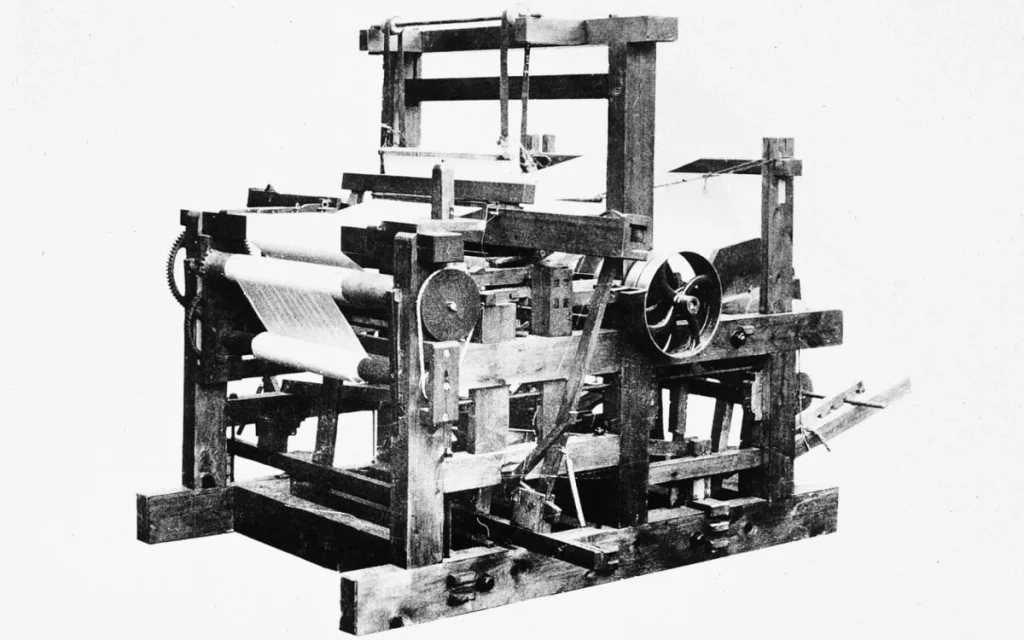
Sakichi Toyoda made weaving machinery, and his automatic loom had a really useful feature. If a problem came up, like a thread snapping, the machine would stop rather than carry on making faulty material. That meant mistakes were caught straight away instead of being found at the end.
In 1929, a British company, Platt Brothers, bought the production and sales rights to the loom for £100,000. According to Toyota UK, Sakichi gave the proceeds to his son, Kiichiro, to develop automotive technology. It wasn’t the only thing behind Toyota, but it helped pay for the move into cars.
This idea of stopping when something goes wrong is called jidoka, and it comes up again later on.
From Toyoda to Toyota: The First Cars
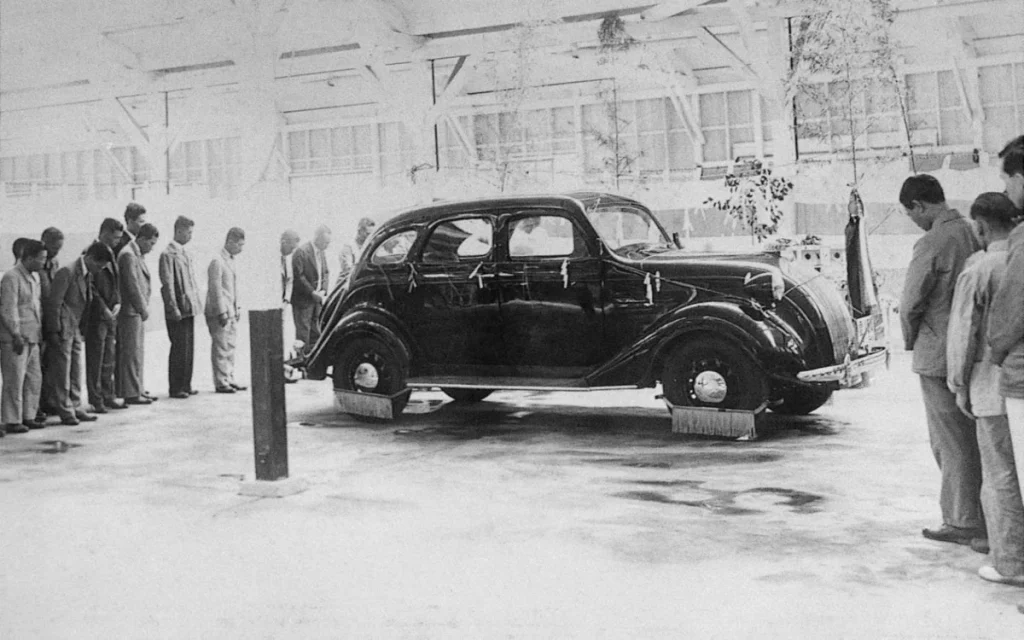
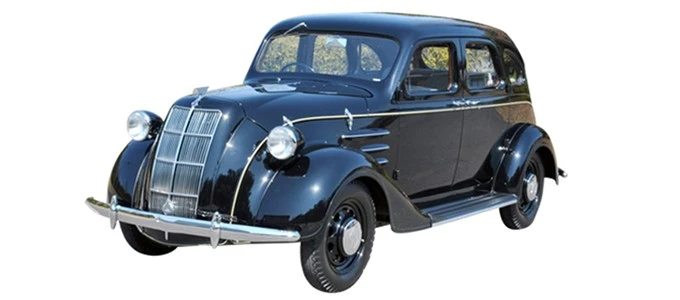
Kiichiro set up an Automotive Division inside Toyoda Automatic Loom Works in 1933. By 1935 there was an A1 prototype car and a G1 truck, so development was properly underway, but neither counts as the first Toyota car.
That was the Model AA, the first Toyota passenger car to reach production, in 1936.
The name changed around then too. In 1936 the company held a public competition to design a new logo, and that led to Toyoda becoming Toyota. Toyota sounds clearer in Japanese, and it’s written with eight strokes, which are linked to good fortune. It also helped the brand move away from being just a family name.
Toyota Motor Co., Ltd. was officially established in 1937, with 28 August as the founding date, and the Koromo plant started operating in 1938. So when Toyota was founded depends on how you look at it. Car development started in 1933, but the motor company itself dates from 1937.
Post-War Growth and the Toyota Production System
After the Second World War, Toyota needed to build more cars and compete with much bigger manufacturers, without a lot of resources to do it. That’s where the Toyota Production System comes in, which is built around two ideas.
The first is jidoka, a Japanese term that’s often described as “automation with a human touch”. If a machine or worker spots a problem, production stops so the fault doesn’t get passed along. It’s the same principle as Sakichi’s loom.
The second is Just-in-Time, which means making and moving only what’s needed, when it’s needed, in the amount needed. Toyota credits Kiichiro with the idea, and Eiji Toyoda and Taiichi Ohno played a big part in turning it into the system Toyota is known for.
In practice, this meant quality was built in during production, with less waste along the way. It’s also how an idea from a loom ended up being used to build cars, and it helped Toyota grow in markets around the world.
Landmark Toyota Models
Rather than go through every model, a few cars show how Toyota’s reach changed over time.
The Land Cruiser was one of Toyota’s early rugged vehicles. The Toyota Jeep BJ arrived in 1951 and was renamed the Land Cruiser in 1954. It was built to go pretty much anywhere.
The Corolla followed in 1966, when Japan was motorising quickly. It was a compact, affordable family car for the mass market, and it put Toyota within reach of a lot more drivers.
In 1967, Toyota launched the 2000GT, a sleek high-performance car. It even featured in the James Bond film You Only Live Twice, if you like a bit of trivia.
By the end of the 20th century, Toyota wasn’t known for just one type of vehicle. The next big changes would affect whole categories of cars and how they were powered.
RAV4 and Prius: Toyota Changes Direction
The RAV4 arrived in 1994. At the time, SUVs were mostly seen as off-roaders, but the RAV4 mixed passenger car comfort with light off-road ability. Toyota says it pioneered the crossover SUV, and plenty of cars on the road today follow the same idea.
The Prius had even bigger consequences. Development began in 1993 with the G21 project, which was about creating a vehicle for the 21st century. The first Prius launched in Japan in 1997 as the world’s first mass-produced hybrid passenger vehicle, and it went on sale in Europe in 2000.
This is why hybrids are so closely linked with Toyota. The Prius wasn’t just another model, it was a different direction. Toyota had gone from improving how cars were built to rethinking how a mass-market car could be powered.
Toyota’s History in the UK
Britain is part of Toyota’s story from a surprisingly early point. That 1929 Platt Brothers deal happened decades before Toyota cars were officially sold here.
The Corona was the first Toyota officially sold in the UK, in 1965, and Toyota (GB) Ltd was introduced in 1967.
Building cars here came later. The first car built at Burnaston in Derbyshire, a Carina E, left the line on 16 December 1992, and Toyota also has an engine plant at Deeside in North Wales. In 2010, Burnaston started building the Auris Hybrid, which ties back to the Prius story.
Not every Toyota sold in the UK is built here, but both plants are still operating today. If you’d like to know more about Toyota’s current manufacturing, take a look at our Manufacturer Spotlight: Toyota.
Where Toyota Is Now
Toyota has come a long way from weaving machinery. Its history now covers mass-market family cars, off-roaders, performance models, crossover SUVs and mass-produced hybrids. Toyota Motor Corporation is still headquartered in Toyota City, Aichi, and the UK side of the story continues at Burnaston and Deeside.
If the history has made you curious about Toyota’s cars, you can explore Toyota at Stoneacre, where you’ll find both new and used Toyotas.