
Whether you’re just starting your driving lessons or have recently passed your driving test, understanding the ins and outs of learner plates is essential for staying legal on UK roads.
From the familiar red L (learner) plates to the optional green P (probationary) plates, and even the Welsh D plates, there’s more to these simple signs than meets the eye.
What Are L Plates and Why Do You Need Them?
If you’re learning to drive in the UK, L plates are absolutely mandatory. These distinctive red-on-white squares must be displayed prominently on both the front and rear of your vehicle whenever you’re behind the wheel as a learner driver.
The consequences of not displaying proper L plates are serious – you could face up to six penalty points on your provisional licence and a fine of around £100. That’s money better spent on additional driving lessons!
Who Needs L Plates?
- All learner drivers on UK roads
- Anyone driving with a provisional licence
- Drivers taking driving lessons with an instructor
- Those practising with friends or family members
Where to Put Learner Plates
Your L plates must be clearly visible on both the front and rear of your vehicle. Avoid placing them on windscreens where they might obstruct your view.

Learner Plate Specifications
You might think any red L on a white background would suffice, but the regulations are surprisingly specific.
The plate itself must be exactly 178mm x 178mm square, with the L measuring 102mm tall and 89mm wide. There are even rules about the thickness of the L’s lines and their positioning within the square.
These precise specifications ensure L plates are easily recognisable to other road users, helping keep everyone safe on the roads.
When you buy L plates from reputable retailers, they should meet these requirements automatically.
Magnetic Learner Plates
Many learners prefer magnetic learner plates for their convenience, especially when sharing the family car with fully licensed drivers. Magnetic L plates are incredibly popular because they’re:
- Easy to remove and reattach
- Perfect for shared vehicles
- Reusable and durable
- Less likely to damage paintwork
Magnetic learner plates are widely available and typically cost between £5-£15 for a pair.
You can purchase L plates, P plates, and magnetic learner plates from most petrol stations, car accessory shops, online retailers, driving schools, driving instructors, and some supermarkets.
When buying online, ensure you’re getting properly sized plates that meet UK regulations.
Who needs P Plates?
Once you’ve passed your driving test, you might consider displaying green P plates. Unlike L plates, these are entirely optional, but they serve a valuable purpose for newly qualified drivers.
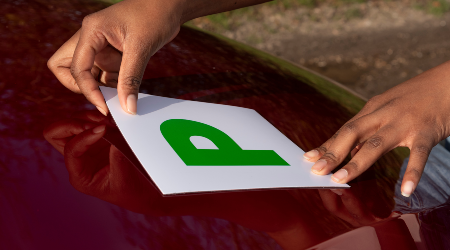
Are P Plates a Legal Requirement?
Pass plates are not legally required anywhere in the UK (except Northern Ireland, where R plates are mandatory for one year after passing). However, many new drivers choose to use them because they:
- Signal to other drivers that you’re inexperienced
- Often results in more patience from other road users
- Give you confidence during your first months of solo driving
- Show off your recent achievement to friends and family
You can display P plates for as long as you like – there’s no time limit. Some drivers keep them on for a few weeks, others for several months until they feel fully confident.
D Plates: The Welsh Alternative
If you’re learning to drive in Wales, you have an additional option. D plates serve the same purpose as L plates but use the Welsh term for learner – “dysgwr”.
These red D plates on white backgrounds can be used instead of or alongside traditional L plates.
However, there’s an important catch: D plates are only valid in Wales. If you’re planning to cross the border into England, make sure you have proper L plates displayed as well.
Learner Plates for Bikes
Learning to ride a motorcycle or moped requires L plates just like cars, but there are some specific considerations for two-wheeled vehicles.
When learning to ride a motorcycle, you must display L plates that are:
- Clearly visible from both front and rear
- Positioned where they won’t interfere with lights or registration plates
- Secure enough to withstand wind and weather at higher speeds
Bike learner plates must still meet the same size specifications and be displayed front and rear. Many riders opt for magnetic learner plates designed specifically for motorcycles.
Ensure your leaner plates for motorcycles don’t obstruct your view, interfere with controls, or create aerodynamic issues that could affect handling.

Can You Drive with Learner Plates If
You’re Not a Learner?
This is a common question, especially for driving instructors and parents of learner drivers. The situation varies depending on who you are.
Driving instructors often keep L plates on their vehicles permanently, which is perfectly legal since they’re regularly teaching learners.
Full licence holders should remove L plates when driving, but shouldn’t face penalties for occasionally forgetting to take them off.
However, deliberately impersonating a learner when you hold a full licence could theoretically cause issues, though prosecution for this is extremely rare.
Ready to Hit the road
Understanding car learner plates might seem complicated, but the key points are straightforward.
L plates are mandatory for all learner drivers, must meet specific size requirements, and need to be clearly displayed front and rear. P plates are optional but helpful for new drivers.
Ready to start your driving journey? Make sure you’ve got properly sized L plates fitted before your first lesson, and remember – they’re not just a legal requirement, they’re an important safety feature that helps other drivers understand your experience level on the road.
Once you’ve got your learner plates sorted, you’ll want to prepare thoroughly for your driving test to give yourself the best chance of success.
If you’re feeling anxious about getting behind the wheel, our top tips for nervous drivers can help build your confidence.
Don’t forget that before your practical test, you’ll need to pass your theory exam – check out our comprehensive guide on 10 steps to the UK driving theory test to get started.