
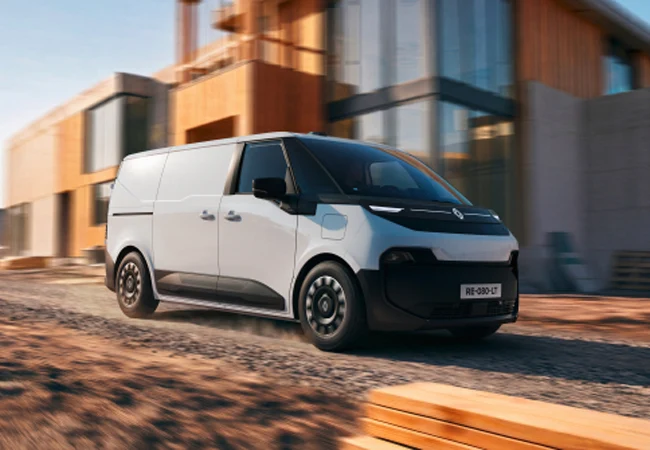
The new Renault Trafic Van E-Tech Electric is bringing a new level of capability to the electric van market. Combining long-range performance, rapid charging, smart technology and genuine commercial practicality, it is designed to meet the demands of modern businesses without compromising the qualities that have made Trafic a trusted name.
Revealed at the 2026 IAA Transportation show in Hanover, the new electric Trafic forms part of Renault’s wider LCV strategy, with five new commercial vehicles planned between now and 2028.
With more than 2.8 million Trafic vans sold since 1980, the latest model takes an established business vehicle into a new electric era.
Long range and lower running costs
For businesses, an electric van needs to do more than reduce emissions. It needs to deliver reliable range, quick charging and competitive operating costs.
The new Trafic Van E-Tech Electric offers more than 292 miles of range, subject to final WLTP homologation. In urban use, that figure can reach nearly 429 miles, potentially allowing up to five working days of driving between charges.
Rapid charging is another major advantage. Its 800V electrical architecture enables the van to recover up to 174 miles of range in just 20 minutes, or up to 236 miles of city range over the same period.
That means less time waiting to charge and more time on the road.
Renault also says the electric Trafic can deliver a total cost of ownership up to 10% lower than an equivalent internal combustion engine model, making the business case even stronger.
All the practicality of a true LCV
Going electric has not meant sacrificing the fundamentals of a working van.
The new Trafic Van E-Tech Electric offers up to 205 cubic feet of load capacity, a payload of up to 1.3 tonnes, or around 2,866 lb, and 2 tonnes of towing capacity, or around 4,409 lb.
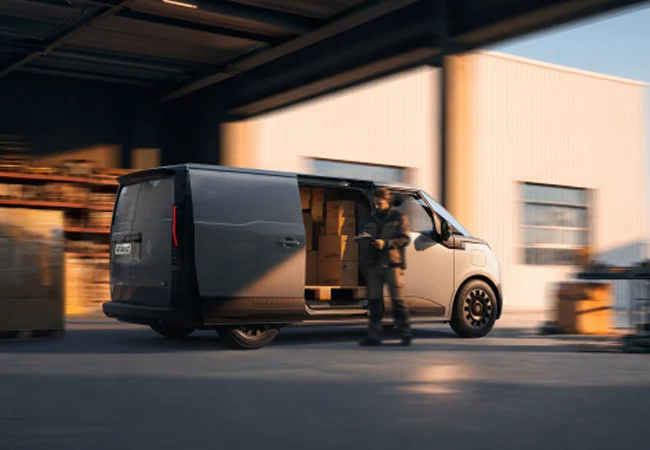
There is room for up to three Euro pallets, while the 21-inch load height makes loading and unloading easier.
A generous 4.3-foot gap between the wheels also provides flexibility for different loads and conversions.
The range will begin with a panel van, available by the end of the year, followed by chassis-cab and crew cab versions in 2027.
Easier and more comfortable to drive
Commercial drivers spend long hours behind the wheel, often navigating busy streets and tight spaces. Renault has therefore focused on making the new Trafic easy to handle as well as practical.
Its 33.8-foot turning circle gives it agility comparable with a Renault Clio, while its 6.2-foot height allows access to standard underground car parks.
Inside, an ergonomic driving position, multi-link rear suspension and the quietness of electric driving are designed to provide a more comfortable, passenger-car-like experience.
Better front and side visibility should also help drivers feel more confident, particularly in busy urban environments.
A van that can keep getting better
One of the biggest innovations is the technology beneath the surface.
The new Trafic Van E-Tech Electric is the first Renault Group vehicle and first LCV in Europe to use Software-Defined Vehicle architecture. This allows the van’s functions to be managed and updated through software.
The system uses two supercomputers running Renault’s CAR OS, an Android-based operating system developed with Google, replacing 80 electronic control units.
For customers, this means the van can evolve over time. Software updates can introduce new features, improve safety and support predictive maintenance throughout the vehicle’s life.
Designed for conversions
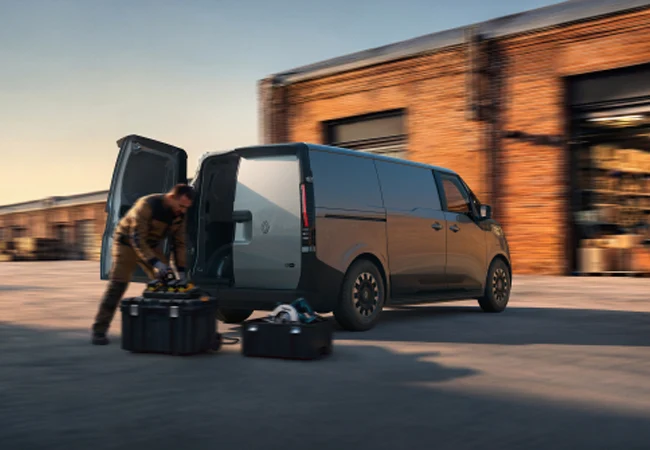
Businesses often need more than a standard panel van, and Renault has designed the Trafic Van E-Tech Electric with conversion in mind.
Its flat floor, spacious load area and 1.3-tonne payload provide a practical base for specialist applications. Vehicle-to-Load (V2L) technology can power electrical equipment directly from the van, which could be useful on building sites and other mobile workplaces.
Renault also plans an ePTO system for heavier conversions, including refrigeration units and ambulance equipment.
The Convertor Companion system takes this further by allowing conversion controls to be integrated into the openR link multimedia system, removing the need for a separate display.
A more sustainable choice
Renault has developed the new Trafic with its entire lifecycle in mind, from production through to end of life.
The company says the electric van’s carbon footprint is more than 45% lower than that of a comparable diesel vehicle. Over 124,000 miles, Renault estimates emissions of around 33 tonnes of CO₂ equivalent, compared with approximately 63 tonnes for a similar diesel van.
An 81 kWh battery provides the claimed 292-mile range, while aerodynamic improvements and a powertrain efficiency of more than 90% help keep energy consumption down.
The van is built at Renault’s Sandouville plant in France, using low-carbon energy and close to many of Europe’s key LCV markets.
Renault uptimize: keeping businesses moving
A van that is off the road cannot earn money, which is why Renault is also introducing Renault uptimize from 2027.
The programme combines real-time vehicle data, artificial intelligence and the van’s Software-Defined Vehicle architecture to help predict potential issues and improve maintenance planning.
Renault’s goal is to halve vehicle downtime following an incident.
Fleet managers will have access to information such as mileage, energy consumption, charging, route planning and driver efficiency, while priority support through Renault’s professional network is designed to get vehicles back into service faster.
With more than 400 Renault Pro+ centres across Europe, the focus is firmly on vehicle availability.
A new benchmark for electric vans?
The new Renault Trafic Van E-Tech Electric is more than an electric version of a familiar van. It brings together the essentials businesses depend on, including load capacity, payload and towing ability, with long range, rapid charging, connected technology and flexible conversion options.
For drivers, it promises a quieter and more comfortable working environment. For fleet operators, it offers the potential for lower running costs and less downtime. And for businesses focused on sustainability, it provides a lower-carbon alternative without abandoning the practical demands of commercial driving. With four decades of Trafic heritage behind it, Renault is clearly aiming for this new electric model to be a significant step forward in the European LCV market.