
There is something unique about a performance Ford. For decades, the blue oval has mastered the art of bringing supercar-slaying performance to both the high street and the special stages. From the homologation heroes born out of rally grit to the multi-million-pound engineering marvels designed to tear up the asphalt at Le Mans, Fast Ford cars hold a truly legendary status among British petrol-heads.
The bloodline is rich with tyre-shredding power, iconic aerodynamic wings, and pure motorsport DNA. Whether you grew up watching the legendary Cosworths dominate British Touring Cars or you are currently dreaming about the latest street-legal track monsters, Ford has always known exactly how to build a proper driver’s car.
But which performance machines truly stand out as the absolute greatest? We look back across the decades, right up to the present day in 2026, to rank the ultimate Fast Fords ever built.
The Le Mans Icon: Ford GT40 Mk IV
When Henry Ford II was snubbed by Enzo Ferrari in a high-stakes buyout meeting, he did not just get angry. He decided to destroy the Italian firm on the world’s most famous racetrack. The result of that legendary corporate feud was the stunning GT40.
While earlier variants secured the famous clean sweep at Le Mans, it was the muscular Mk IV that took the concept to its absolute extreme in 1967. Designed and built specifically to conquer the high-speed demands of the French circuit, it featured a lightweight honeycomb aluminium chassis wrapped around a massive American V8.
During its competitive prime, it set unofficial speed records along the terrifying Mulsanne straight, clearing a mind-boggling 220 mph. It remains a masterpiece of aerodynamic innovation and raw American muscle, proving that Ford could beat the finest sports car builders in the world at their own game.
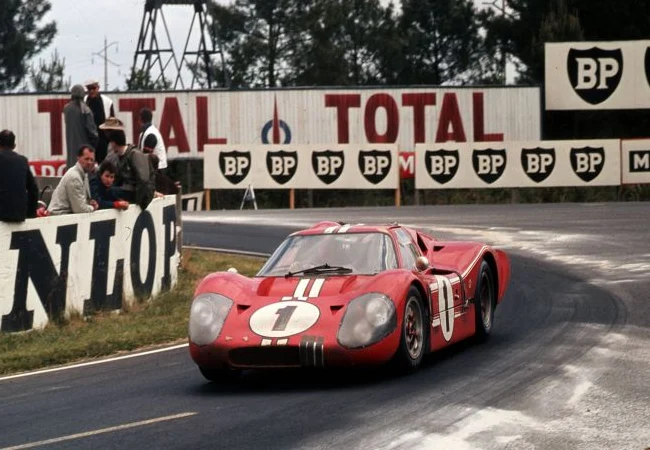
- Year in Production: 1967
- Engine Size: 7.0-litre V8
- Power in bhp: 500 bhp
- Gearbox: 4-speed manual
- 0-60 speed: 3.8 seconds
- Top speed: 220 mph
The Group B Rocket: Ford RS200 Evolution
The mid-1980s was an era defined by the unhinged, dangerous, and utterly brilliant Group B rallying category. To compete with the all-wheel-drive masterclasses from Europe, Ford created a bespoke, mid-engined weapon called the RS200. With a composite body styled by Ghia and a complex four-wheel-drive system, it looked like nothing else on the road.
The standard car was quick, but the ultra-exclusive Evolution variant was completely off the scale. Ford engineers extracted immense performance out of a highly tuned Cosworth BDT engine.
For years, this mid-engined beast sat proudly in the Guinness Book of World Records as the fastest accelerating production car on earth, rocketing from a standstill to 60 mph in a brutal, neck-snapping 2.0 seconds flat. It is a terrifyingly focused piece of engineering that represents the absolute zenith of the Fast Ford rally heritage.
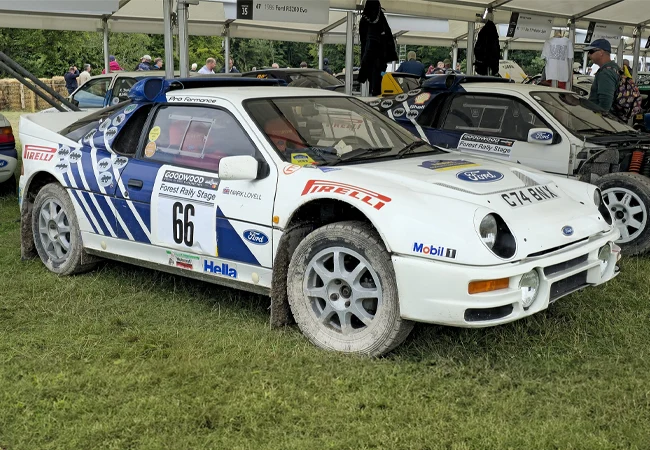
- Year in Production: 1986
- Engine Size: 2.1-litre turbocharged inline-4
- Power in bhp: 572 bhp
- Gearbox: 5-speed manual
- 0-60 speed: 2.0 seconds
- Top speed: 169 mph
The Working-Class Hero: Ford Escort RS Cosworth
You cannot talk about Fast Fords in the UK without mentioning the car that defined a generation of car enthusiasts. The Escort RS Cosworth was a thinly veiled rally car built for the road, designed specifically to homologate Ford’s entry into the World Rally Championship.
With its flared arches, aggressive front splitter, and that utterly unmissable “whale-tail” rear wing, the Escort Cosworth had an unmatched presence. Beneath the bodywork sat a longitudinal two-litre turbocharged engine mated to a permanent four-wheel-drive system that offered incredible grip on damp British B-roads.
It quickly became the ultimate blue-collar status symbol, capable of embarrassing exotic sports cars costing three times as much. It remains one of the most desirable collector cars in the UK car scene.
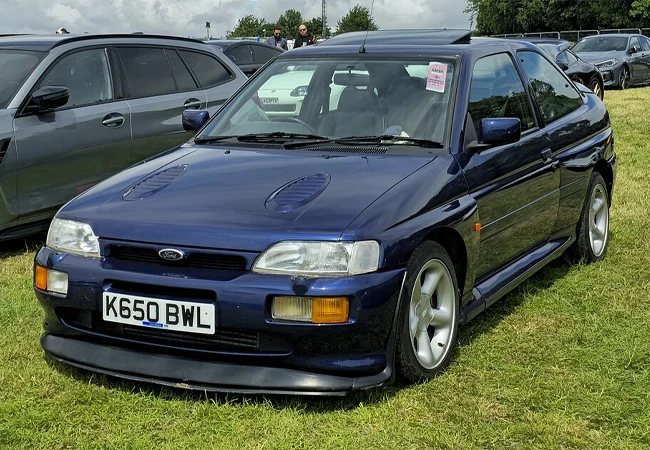
- Year in Production: 1992
- Engine Size: 2.0-litre turbocharged inline-4
- Power in bhp: 224 bhp
- Gearbox: 5-speed manual
- 0-60 speed: 5.7 seconds
- Top speed: 140 mph
The Analogue Supercar: Ford GT
To celebrate Ford’s centenary, the company decided to resurrect the spirit of its most famous race car. The 2005 Ford GT was an incredible retro-styled tribute to the original GT40, though it was significantly wider, taller, and entirely re-engineered for the modern world.
Unlike the high-tech, semi-automatic supercars arriving from Italy at the time, the Ford GT was a delightfully old-school driver’s machine. It featured a mid-mounted, supercharged V8 engine that delivered a mountain of torque directly to the rear wheels via a slick six-speed manual gearbox.
There were no complicated electronic driver aids or paddle-shifters here, just pure mechanical connection. It was a critical darling that instantly achieved classic status, hitting a top speed of 205 mph while sounding like a vintage Can-Am racer.
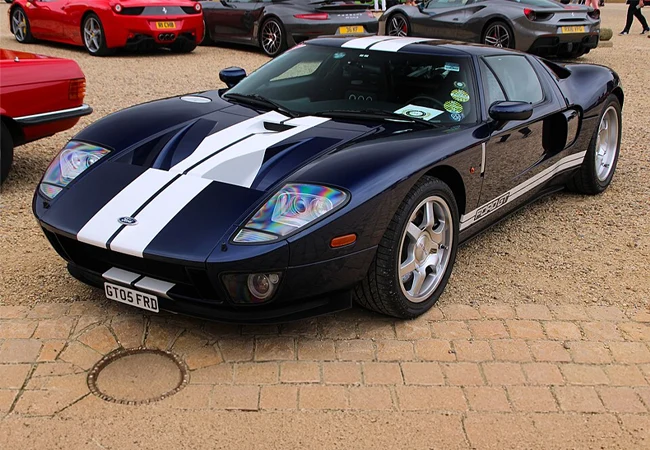
- Year in Production: 2005-2006
- Engine Size: 5.4-litre supercharged V8
- Power in bhp: 550 bhp
- Gearbox: 6-speed manual
- 0-60 speed: 3.5 seconds
- Top speed: 205 mph
The Ultimate Hot Hatch: Ford Focus RS Mk2
While American branches of the company were busy fighting the horsepower wars with the Shelby GT500, Ford of Europe was busy perfecting the fast hatchback. The second-generation Focus RS arrived with an absolute sledgehammer of an engine: a warbling, 2.5-litre five-cylinder turbocharged unit sourced from Volvo.
Sending 301 bhp directly through the front wheels sounds like a recipe for immediate tyre smoke and uncontrollable torque steer. However, Ford engineers developed a clever front suspension setup called the RevoKnuckle, alongside a Quaife limited-slip differential, to let the front rubber actually bite into the tarmac.
With its aggressive bonnet vents, wide arches, and optional Ultimate Green paintwork, the Mk2 Focus RS brought genuine supercar theatre to the high street. It proved that you did not need a mid-engined layout to feel like a driving god on British country lanes.
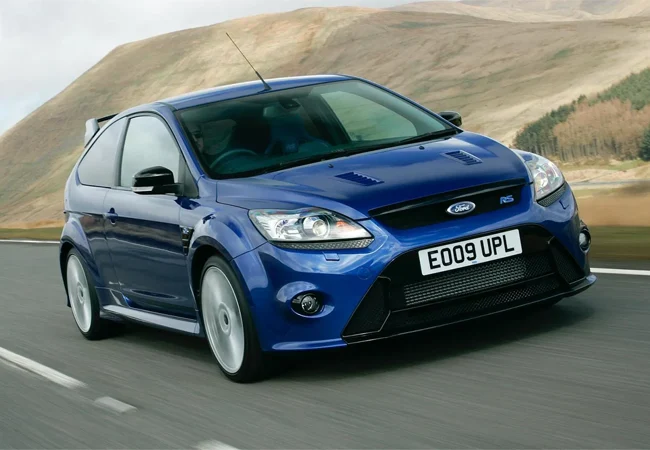
- Year in Production: 2009-2011
- Engine Size: 2.5-litre turbocharged 5-cylinder
- Power in bhp: 301 bhp
- Gearbox: 6-speed manual
- 0-60 speed: 5.9 seconds
- Top speed: 163 mph
The Ultimate Road-Legal Weapon: Ford Mustang GTD
Forget everything you think you know about traditional muscle cars, because this vehicle exists in an entirely different universe. The Mustang GTD is essentially a street-legal GT3 racing car disguised as a road car, developed alongside the extreme machines running at the world’s most demanding circuits.
Beneath the radical, carbon-heavy bodywork lies a brutal, supercharged 5.2-litre V8 that pumps out an incredible 815 horsepower. Ford threw out the standard rear suspension layout to install an advanced, visible inboard pushrod suspension system, matching it with a dual-clutch transaxle gearbox in the back to achieve a near-perfect weight distribution.
Its primary mission was to humiliate European exotic supercars on their own home turf at the Nürburgring. It did exactly that, setting a blistering, official time of 6 minutes and 40.835 seconds, cementing its place as the fastest street-legal American car to ever lap the legendary track.
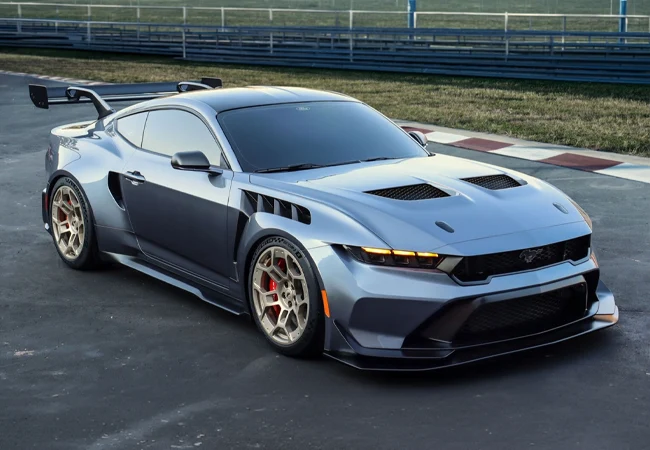
- Year in Production: 2025
- Engine Size: 5.2-litre supercharged V8
- Power in bhp: 815 bhp
- Gearbox: 8-speed dual-clutch automatic
- 0-60 speed: 3.2 seconds
- Top speed: 202 mph
The Unrestricted Track Master: Ford GT Mk IV
If the road-going supercars still sound a bit too compromised for your taste, Ford created a final, unrestricted farewell to its flagship mid-engined program. The track-only Ford GT Mk IV is the absolute pinnacle of pure internal combustion performance, completely unbound by any racing regulations or road-legal restrictions.
Engineers pushed the EcoBoost V6 past 800 horsepower, pairing it with an aggressive racing transaxle and an extreme, long-tail carbon fiber body designed purely for high-speed downforce.
In spring 2026, Ford officially wrote its name into the history books by letting factory driver Frédéric Vervisch loose on the Nürburgring Nordschleife. The unrestricted beast laid down a mind-boggling lap time of 6 minutes and 15.977 seconds. This historic run officially crowns the GT Mk IV as the fastest purely petrol-powered vehicle to ever lap the Green Hell, securing a third-place overall spot behind only two highly experimental, non-production hybrid and electric prototypes.
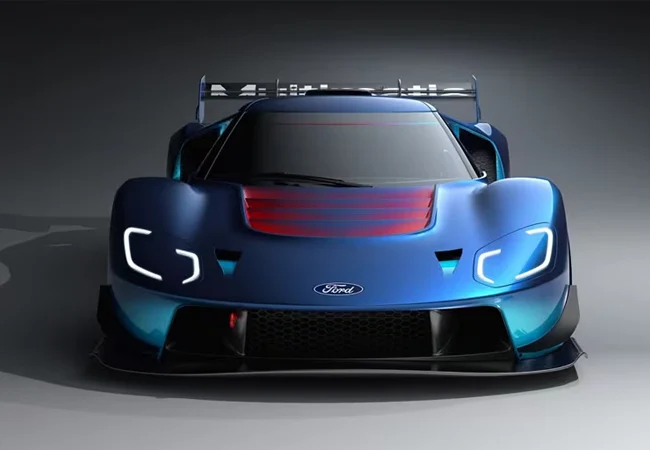
- Year in Production: 2023-2024
- Engine Size: 3.5-litre twin-turbo V6
- Power in bhp: 800+ bhp
- Gearbox: 6-speed racing transaxle
- 0-60 speed: 2.5 seconds (approximately)
- Top speed: 220 mph (approximately)
Which Fast Ford Reigns Supreme?
Whether your heart belongs to the analogue, supercharged noise of the 2005 GT, the rally-bred madness of the RS200, the five-cylinder warble of the Focus RS, or the modern, record-breaking engineering of the Mustang GTD, there is no denying that Ford’s performance history is incredibly special.
Fast Fords have always succeeded because they possess a distinct personality. They are loud, aggressive, visually striking, and completely focused on delivering maximum driver enjoyment. Ford has repeatedly proven that it can build cars capable of trading blows with the absolute best performance brands on earth. Long live the fast blue oval.